Every estate runs on its service charge. It pays the security guards, keeps the streetlights on, clears the drainages and maintains the gatehouse. But deciding how much to charge, and getting residents and landlords to agree, trips up even experienced committees. Too low and the estate cannot pay the guards by August. Too high and residents refuse to pay. Here's how to get it right.
Start with what the estate actually covers
Before picking a number, distinguish between communal estate expenses and individual household responsibilities. In most Nigerian estates, power (generators, solar, inverters) and water (boreholes and pumping machines) are handled individually by homeowners and landlords. The estate service charge covers only shared, communal services.
- Security guards: day and night gate guards, supervisor, gatehouse access control, and guardhouse welfare (by far the single largest estate expense).
- Street lighting & gate power: common area PHCN bills, solar streetlights upkeep, and small fuel for the gatehouse.
- Sanitation & drainage: street sweepers, regular drainage clearing, bush clearing, and pest fumigation.
- Waste management: local PSP or waste collector coordination and common disposal fees.
- Repairs and perimeter upkeep: entrance gate repairs, road patching, perimeter security, and painting.
- Admin, tools & software: estate management software (BreeUp), Zoom (for virtual AGM and committee meetings), Google Drive (for shared estate records, meeting minutes and financial reports), plus secretary allowance.
- Reserve / Sinking fund: an emergency cushion (typically 10%) reserved strictly for sudden community emergencies like transformer repairs or gate failure.
Add it up, then divide fairly
Total the annual communal expenses, add the reserve fund, and divide by the number of households. That gives you the exact service charge per household per year. The rule should be simple enough to explain in one sentence at the AGM.
Why yearly billing beats monthly chasing
On paper, monthly billing sounds lighter on residents' pockets. In reality, monthly billing is impractical and exhausting. Chasing 50 or 60 households twelve times a year turns the committee and landlords into perpetual debt collectors, and leaves the estate constantly short on funds for guards and streetlights.
- Aligned with tenancy leases: Most tenants and landlords prefer paying the service charge once a year at the start of their lease or annual renewal, exactly when rent is paid.
- Guarantees operational cashflow: Upfront annual collections give the estate the liquidity needed to fund bulk diesel purchases, retain security companies, and service boreholes without monthly panic.
- Eliminates constant chasing: Billing once a year means one round of follow-up instead of twelve.
- Clean landlord-to-tenant passthrough: Landlords collect the annual service fee directly alongside rent, and remit the full amount to the estate in one clean transaction.
- Handling exceptions: For households with genuine cashflow constraints, the committee can permit half-yearly (bi-annual) payments, but the estate's default standard should always be a yearly fee paid upfront.
Separate the service charge from one-off levies
The service charge covers running costs. A new borehole, road resurfacing or a playground is a capital project and should be billed as a separate levy, approved at an AGM. Mixing the two into one charge makes residents feel the service charge keeps going up, and makes it harder to show where the money went.
Get residents to agree
- Show the budget
Present the spending breakdown and the proposed charge at an AGM or special general meeting. Residents who can see the numbers argue about detail, not principle.
- Compare with last year
Show what's changed: if diesel is up 40%, say so. If cleaning costs fell because you renegotiated, show that too.
- Offer options, not surprises
If the charge needs to go up, present two or three scenarios and let residents choose. A 15% increase they voted for goes down better than a 10% increase they found on their bill.
- Vote and record it
Record the resolution, the vote count, and the effective date. This protects the committee and settles arguments later.
After the AGM
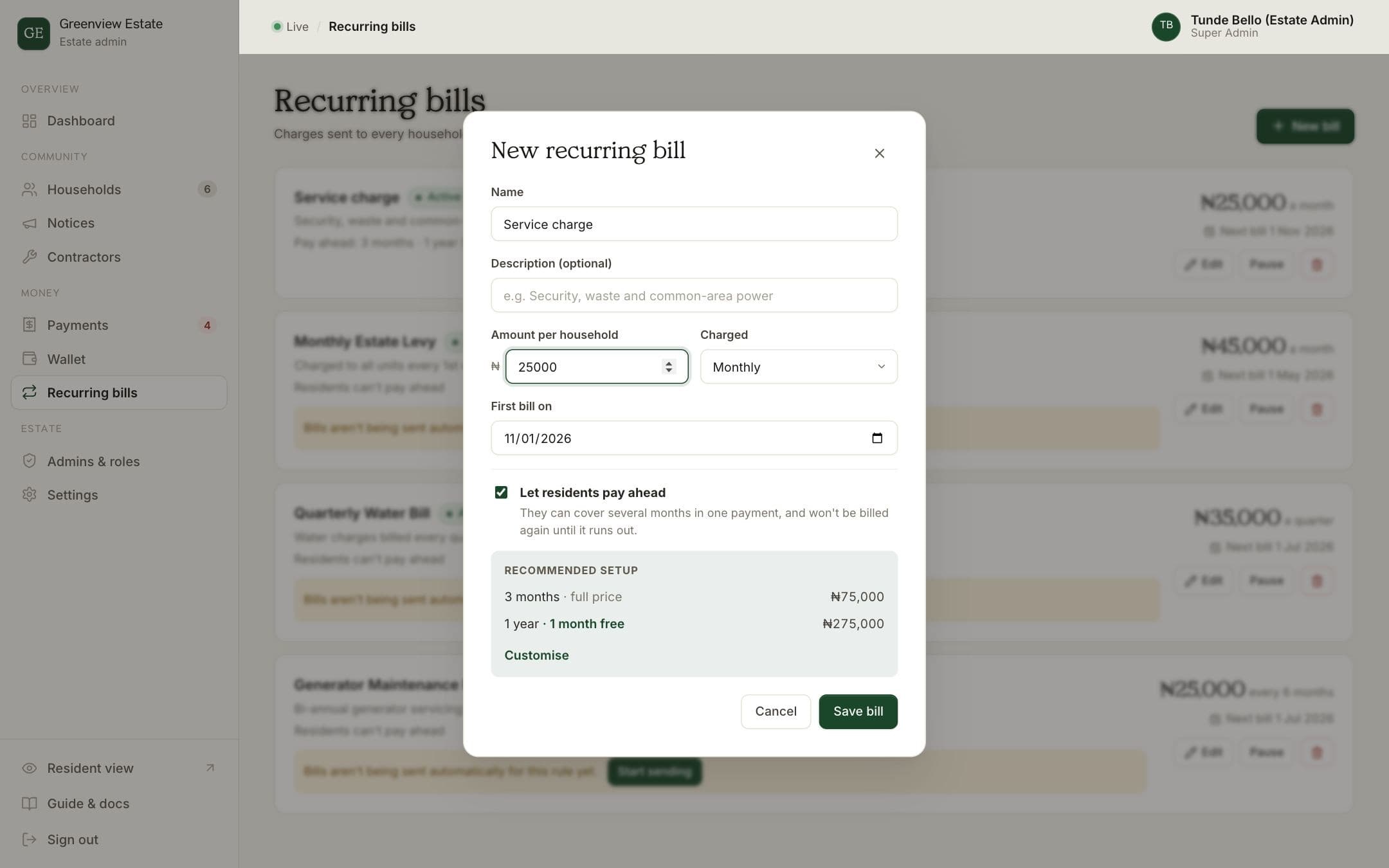
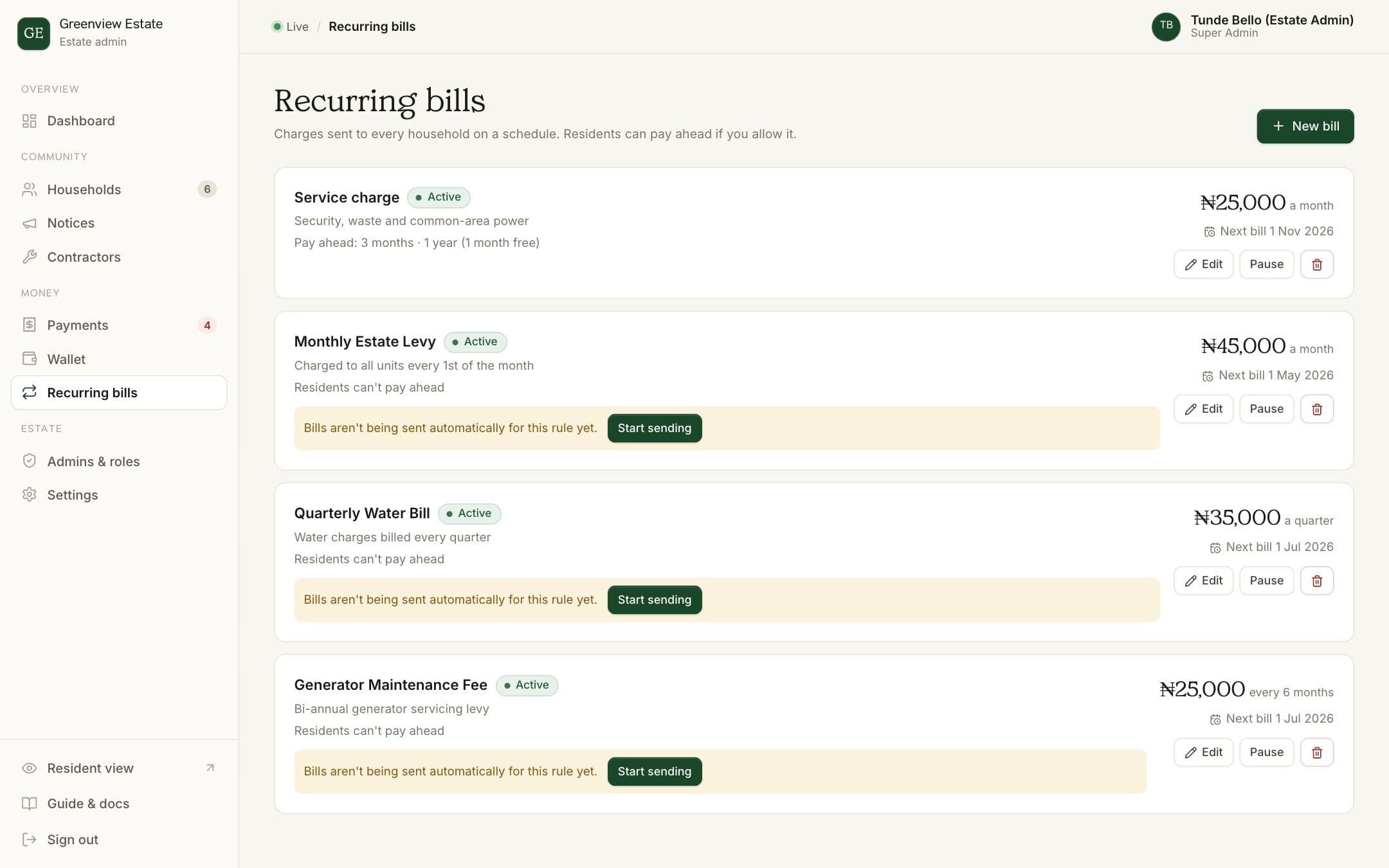
- Set up the approved charge as a recurring bill so every household gets their invoice automatically.
- Send a notice summarising what was agreed: the amount, when it starts, the payment reference and the estate's account details.
- Offer a pay-ahead option with a small discount. Residents who pay the year upfront give the estate cash flow and one less person to chase.
- Review the charge every year. Costs change, and a charge that was right last year may fall short this year.